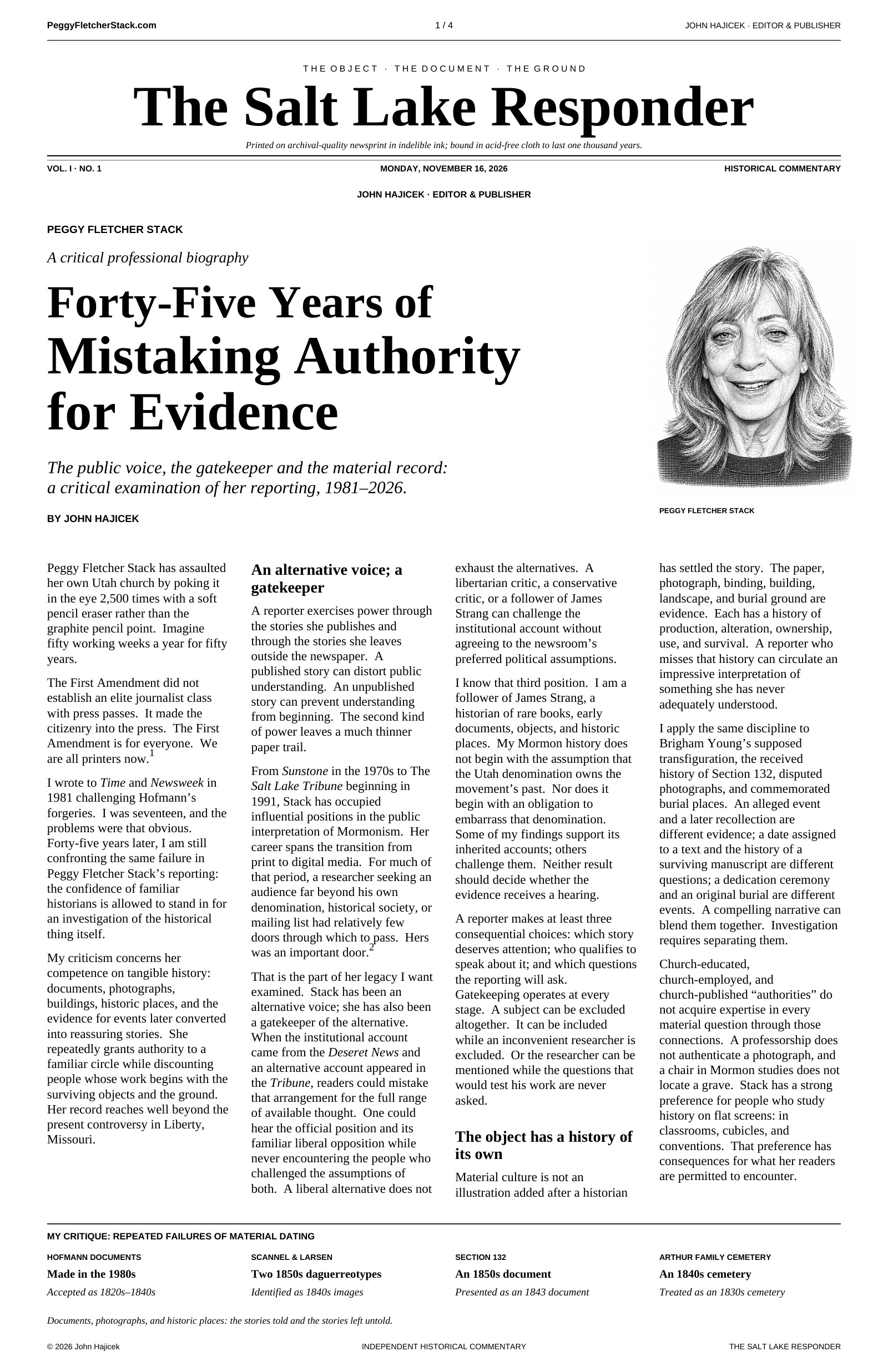
Forty-Five Years of Mistaking Authority for Evidence
Peggy Fletcher Stack has assaulted her own Utah church by poking it in the eye 2,500 times with a soft pencil eraser rather than the graphite pencil point. Imagine fifty working weeks a year for fifty years.
The First Amendment did not establish an elite journalist class with press passes. It made the citizenry into the press. The First Amendment is for everyone. We are all printers now.1
I wrote to Time and Newsweek in 1981 challenging Hofmann’s forgeries. I was seventeen, and the problems were that obvious. Forty-five years later, I am still confronting the same failure in Peggy Fletcher Stack’s reporting: the confidence of familiar historians is allowed to stand in for an investigation of the historical thing itself.
My criticism concerns her competence on tangible history: documents, photographs, buildings, historic places, and the evidence for events later converted into reassuring stories. She repeatedly grants authority to a familiar circle while discounting people whose work begins with the surviving objects and the ground. Her record reaches well beyond the present controversy in Liberty, Missouri.
An alternative voice; a gatekeeper
A reporter exercises power through the stories she publishes and through the stories she leaves outside the newspaper. A published story can distort public understanding. An unpublished story can prevent understanding from beginning. The second kind of power leaves a much thinner paper trail.
From Sunstone in the 1970s to The Salt Lake Tribune beginning in 1991, Stack has occupied influential positions in the public interpretation of Mormonism. Her career spans the transition from print to digital media. For much of that period, a researcher seeking an audience far beyond his own denomination, historical society, or mailing list had relatively few doors through which to pass. Hers was an important door.2
That is the part of her legacy I want examined. Stack has been an alternative voice; she has also been a gatekeeper of the alternative. When the institutional account came from the Deseret News and an alternative account appeared in the Tribune, readers could mistake that arrangement for the full range of available thought. One could hear the official position and its familiar liberal opposition while never encountering the people who challenged the assumptions of both. A liberal alternative does not exhaust the alternatives. A libertarian critic, a conservative critic, or a follower of James Strang can challenge the institutional account without agreeing to the newsroom’s preferred political assumptions.
I know that third position. I am a follower of James Strang, a historian of rare books, early documents, objects, and historic places. My Mormon history does not begin with the assumption that the Utah denomination owns the movement’s past. Nor does it begin with an obligation to embarrass that denomination. Some of my findings support its inherited accounts; others challenge them. Neither result should decide whether the evidence receives a hearing.
A reporter makes at least three consequential choices: which story deserves attention; who qualifies to speak about it; and which questions the reporting will ask. Gatekeeping operates at every stage. A subject can be excluded altogether. It can be included while an inconvenient researcher is excluded. Or the researcher can be mentioned while the questions that would test his work are never asked.
The object has a history of its own
Material culture is not an illustration added after a historian has settled the story. The paper, photograph, binding, building, landscape, and burial ground are evidence. Each has a history of production, alteration, ownership, use, and survival. A reporter who misses that history can circulate an impressive interpretation of something she has never adequately understood.
I apply the same discipline to Brigham Young’s supposed transfiguration, the received history of Section 132, disputed photographs, and commemorated burial places. An alleged event and a later recollection are different evidence; a date assigned to a text and the history of a surviving manuscript are different questions; a dedication ceremony and an original burial are different events. A compelling narrative can blend them together. Investigation requires separating them.
Church-educated, church-employed, and church-published “authorities” do not acquire expertise in every material question through those connections. A professorship does not authenticate a photograph, and a chair in Mormon studies does not locate a grave. Stack has a strong preference for people who study history on flat screens: in classrooms, cubicles, and conventions. That preference has consequences for what her readers are permitted to encounter.
Hofmann: a forgery becomes historical authority
Stack’s public authority developed at Sunstone before she joined The Salt Lake Tribune in 1991. The Religion News Association honored her with its lifetime achievement award in 2023. Professional recognition makes scrutiny of her historical judgment more necessary: her choices help determine which discoveries receive a public audience and which challengers remain outside it.3
In the March–April 1981 Sunstone, Susan Oman and Peggy Fletcher jointly signed “From the Editors,” concerning the forged Joseph Smith III blessing. They wrote: “No one we talked to doubted the authenticity.” They reproduced the document, narrated the purported blessing as an actual event, and argued that the accepted succession history required revision. Their conclusion invoked historians: “With their help, challenging discoveries can be anticipated and relished.” A forgery had become authority for instructing readers about the past.4
Her September 1982 Sunstone Review interview gave Hofmann an extensive platform for supposed discoveries involving Joseph Smith III, Lucy Mack Smith, Martin Harris, and additional manuscripts. She asked about authentication, but also accepted the finds’ supposed historical importance when asking why the Utah church was not pursuing more: “why isn’t the Church itself going after them?” The interview supplied publicity and credibility. It did not expose the fraud.5
Jan Shipps later recalled Fletcher seeking a prominent opening session on the Salamander Letter for the August 1984 Sunstone symposium, despite reservations that the discussion was premature. That was a decision about programming and amplification. The document was already becoming a vehicle for explaining Mormon origins before it had survived the scrutiny it needed.6
Her continued acceptance is documented through October 28, 1985, thirteen days after the fatal bombings. The Christian Science Monitor reported: “Fletcher says she believes the Hofmann documents, including the salamander letter, are authentic.” The report also named Leonard Arrington and Jan Shipps as believers. Agreement among respected historians had supplied no protection against the forger.7
Her 2021 retrospective acknowledged Sunstone’s extensive publicizing and debating of the finds, her speculation that the bomber was a devout Latter-day Saint angered by them, and the lies Hofmann had told her. Later recognition does not erase the decisions made while his reputation was growing. I was raising objections as a teenager; she was helping confer editorial authority on the discoveries.8
Had she helped expose the forgery in 1981, her platform could have interrupted the accumulation of credibility that helped Hofmann market later fabrications. Buyers and readers might have encountered an investigation of a forger before encountering another celebrated discovery. What might have changed if she had investigated the credibility she was helping to create? That failure belongs in her professional biography.
The Elvis book: another story ahead of authentication
The pattern also appears in her July 2001 feature about a Book of Mormon supposedly annotated by Elvis Presley. She reported reservations, yet told readers: “At least this legend has a paper trail.” In 2018, Church History Library director Keith Erekson established that the annotations were forged. His published investigation specifically criticized her detailed recital and tepid conclusion. A paper trail for a story had not authenticated the handwriting in the book.9
Stack and David Noyce later featured Erekson’s myth-debunking work on Mormon Land. That later discussion does not recover the years in which the story circulated around an unverified object. The journalistic question was available from the beginning: who had examined the writing, and what had that examination established?10
Scannel and Larsen: confidence recirculated
My conclusion about the two Romig-associated daguerreotypes is plain: neither is a photograph of Joseph Smith. I am not publishing my authentication case here. I am examining how Stack promoted the later identification after she had already reported serious objections to the earlier one.
Romig’s advocacy of the earlier image was public in 1994. The Deseret News reported his 85-to-90-percent confidence that it depicted Joseph Smith, while recording Ephraim Hatch’s rejection. In May 2008, Stack covered the Scannel photograph through S. Michael Tracy’s identification, objections from daguerreotype specialist Dennis Waters, and the institutions’ refusal to confirm the sitter. She already had a reporting standard she could apply to another Romig-associated identification.11
Her July 21, 2022, Larsen article nevertheless declared in her own narrative: “The daguerreotype, on the other hand, captured Smith in a matter of minutes.” That sentence made Joseph Smith the sitter. It was the reporter’s assertion, not merely an enthusiastic source speaking. The same article reported that the Utah church could not identify the man. Her narrative certainty exceeded the uncertainty she herself had recorded.12
By June 20, 2026, she emphasized that the photograph “significantly hasn’t yet been disproved.” Missing refutation was being made to support an affirmative identification. On October 8, covering the film Brother Joseph Again, she wrote: “Like math students solving a complicated equation, though, they had to show their work. Now they have.” The language repeatedly carried readers toward acceptance. This is what I mean by being all-in: an identification becomes the premise from which the reporter explains its significance.13
There is also a concrete omission involving my own voice. The film’s official website lists me among its featured experts. Rick Bennett’s October 5 account identified me as a contributor who remained skeptical. Stack’s October 8 article cited that account and quoted the adjacent discussion of the locket’s history, but did not name me. She cited the very account that identified me as a skeptic and left my name out of her article.14
An experienced reporter could have asked why a practitioner dealing in the relevant original objects rejected the identification that her favored sources promoted. That would have exposed her readers to a materially different kind of expertise. Instead, the discovery received another affirmative narrative while the publicly identified dissenter disappeared from her account.
The photographic disputes expose the same editorial question. An alleged image of Joseph Smith can become a sensation because it offers readers a startling face and historians an exciting announcement. Its dramatic effect can outrun the examination of the object. Meanwhile, an argument about the preservation of Mormon graves may require deeds, landscape reconstruction, burial history, and sustained attention. The difference in their immediate appeal does not determine their historical importance.
Section 132: the chronology becomes the premise
This dependence on received authority also appears in her treatment of Section 132. In April 2008, her own historical narration stated: “In 1843, Smith recorded what he said was a divine revelation.” That chronology became the premise of the explanation. My challenge concerns the attribution and history of the document; repeating its assigned date does not answer it.15
By July 2024, the introduction to her Mormon Land episode with David Noyce called challengers “so-called polygamy deniers” and selected Matthew Bowman and Brooke LeFevre to explain the controversy. In July 2026, she repeated that framing and gave substantial explanatory authority to Bowman and Church History Department officials, alongside other established interpreters. The article also carried criticism from Cheryl Bruno and Michelle Stone. My objection is to a structure in which established interpreters define the dispute and dissenters enter already wearing a dismissive label.16
A “small coterie”: do the arithmetic
Peggy Fletcher Stack’s July 18, 2026, Mormon Land article in The Salt Lake Tribune announces its verdict through its vocabulary: defenders of the inherited Utah narrative are treated as historians, while those who test its documentary foundations are dismissed as “so-called polygamy deniers.” The article invokes the William Clayton diaries, whose promised full annotated edition the Utah church still has not published, and then compresses Matt Grow’s account of an enormous alleged Nauvoo network into a “small coterie.” This is not dispassionate historical reporting. It is the old Utah story presented as settled history before the promised annotated edition has even been published.17
This is what a conspiracy theory looks like: “[President] Smith first introduced the practice of plural marriage to a small coterie of colleagues, [Matt] Grow says.” Stack then reports Grow’s claim that the practice remained largely secret from the majority of church members. But the theory becomes even crazier when one performs the arithmetic its advocates generally avoid. The Utah church itself claims that, apart from Joseph and his wives, another twenty-nine men and fifty women had entered plural marriage by June 1844. The alleged network places such central figures as Hyrum, Heber, Brigham, Clayton, Whitney, and, ahhhhh yes, Joseph Kingsbury around the president. Depending upon whether Joseph is assigned thirty, forty, or fifty wives, the theory begins with 110 to 130 direct participants. That is not a “small coterie.” It is already a substantial clandestine society centered upon the president himself.18
And that figure counts only the direct participants. It does not include Emma; the lawful husbands and wives; the parents who supposedly surrendered daughters; the husbands who supposedly surrendered wives; the siblings and children living within the households; the officiators who performed the ceremonies; the witnesses who authenticated them; the clerks who recorded or copied them; the messengers and intermediaries who arranged them; or the friends, confidants, neighbors, and household members expected not to notice them. Once the theory is stated in its actual dimensions, I estimate that it requires perhaps three hundred to five hundred people to have known, facilitated, concealed, or lived in immediate proximity to a sexual and marital conspiracy surrounding the president himself; yet nearly all of them supposedly maintained an astonishing collective silence.
The secret society and its public accusers
And from whom does the story publicly emerge? From three murderous propagandists: John C. Bennett, whose defamatory book manufactured a lurid public case against Joseph Smith; Thomas Sharp, whose newspaper demanded “war and extermination” and incited vengeance by “powder and ball”; and William Law, whose defamatory Nauvoo Expositor supplied the immediate pretext for the final campaign against Joseph and Hyrum Smith. These were not three detached observers who happened to disclose an inconvenient secret. They were three enemies who published inflammatory accusations against the men whose destruction they encouraged. Perfection. The theory asks us to believe that hundreds of alleged participants, spouses, parents, relatives, clerks, witnesses, neighbors, and household members preserved the secret, while the reliable truth emerged principally from the defamatory publications of three men who helped create the murderous atmosphere in which Joseph and Hyrum were assassinated.19
This is the same degenerating logic encountered in chemtrail theories, moon landing hoaxes, and claims that the nineteen hijackers acted in concert with the president: every documentary absence requires another conspirator; every contradiction requires another concealed arrangement; and every failure of contemporary evidence is converted into proof of the conspiracy’s supernatural efficiency. Exercise a little historical discrimination and distinguish Illinois documents of the 1840s from Utah folklore of the 1890s? No.
Peggy Fletcher Stack is the reporter; “small coterie” is her characterization of Matt Grow’s account. The phrase disguises the dimensions of his conspiracy theory behind language calculated to make an enormous clandestine society sound like a handful of intimates. His theory requires Joseph Smith, thirty to fifty alleged wives, twenty-nine additional men, fifty additional women, and hundreds of lawful spouses, parents, siblings, children, witnesses, officiators, clerks, intermediaries, confidants, and household members to have participated in, facilitated, concealed, or lived alongside an immense sexual and marital conspiracy surrounding the president himself. The alleged harem cannot keep enlarging and its indispensable participants multiplying while the resulting conspiracy is called a “small coterie.”
Benjamin Park and Matthew Bowman cannot answer every material question by virtue of being professors. Park’s presence in her photographic coverage and Bowman’s in her polygamy coverage demonstrate her preference for academic interpreters. The investigative task is to find expertise fitted to the disputed evidence. A reporter must test the familiar explanation instead of allowing a familiar name to settle the question.
Historic places survive outside the classroom
My involvement in disputed Mormon historic sites was public decades before Liberty. In 1992 I presented Mormons in Wisconsin: A Closer View of the Early Settlements, 1835–1875 to the State Historical Markers Council, Burlington City Council, and Park Board. It challenged the Echo Park marker’s treatment of Moses Smith and the Wisconsin settlements, including the omission of Voree. It addressed surviving houses, the Cemetery of the Saints, and the Voree temple site. This was work on places and public commemoration, not a dispute invented for social media.20
A historical marker is a modern object carrying an interpretation of the past. Its placement does not become evidence for an earlier grave simply because institutions cooperated in erecting it. The distinction between a memorial and a burial place is elementary. It matters profoundly when a development threatens ground outside the boundary of the later commemorative site.
Stack’s own preservation reporting supplies a standard she should apply consistently. In March 2021 she described the removal of Salt Lake Temple murals as a loss. Yet her November 2021 Provo Temple story with Scott D. Pierce introduced the proposed transformation as a “makeover,” even as it printed a preservationist’s objections. The word domesticates the loss. Replacing an original architectural form does not preserve it, and a photograph or replica does not restore a destroyed object.21
The same attention to tangible survival belongs in Missouri. My research concerns a plantation landscape, Mormon refuge, enslaved people, and the burial ground I identify with Christian Whitmer and Peter Whitmer Jr. The questions require investigation of the site and its records. The status of the people who favor an existing monument cannot answer where earlier bodies were buried. The people bought and sold, including children, belong in that history as surely as the mansion and its later monuments.
The story she declined
In our Messenger exchange, I asked Stack: “Are you still interested in this story, or did you quit on account of Romig?” She replied: “I am not pursuing it at this time - and not just because of Romig. Other historians, too.” Her answer expressly identified Romig and other historians as reasons for not pursuing my story.22
That is gatekeeping with a tangible consequence. The people whose authority I challenged helped persuade a reporter not to pursue the challenge. I wanted an investigation of the place and the records; her answer named the historians behind her decision to stop.
That is precisely where investigative reporting should begin. What do the original records establish? What has each participant examined? Which conclusions depend upon later repetition? Who possesses relevant knowledge outside the familiar professional circle? A reporter who asks only whether recognized historians approve a discovery has allowed those historians to help decide which challenges to their own interpretations the public will encounter.
The gatekeeper of the alternative
Stack’s liberal and feminist commitments become a journalistic liability when they supply the boundaries within which a story must fit. My objection is to a familiar pattern of social outrage becoming the organizing principle of historical coverage. A question about an object becomes a question about somebody’s feelings. A question about provenance becomes a conversation among approved authorities. The public receives a controversy with recognizable political roles, while the historical problem remains unexamined.
The recurring professor can become part of that arrangement. A professor is a convenient source: available, articulate, and familiar with the language of an educated newsroom. But a title does not establish competence in every kind of evidence. Classrooms, cubicles, and conventions do not confer universal authority over early manuscripts, photographic objects, archaeological ground, or burial geography. Those subjects demand experience with the particular materials under examination.
When a reporter repeatedly consults the same circle, its members acquire an additional kind of authority: they become the people through whom other people must pass. Their judgment helps determine which discoveries become news and which discoverers remain outsiders. The circle then appears indispensable because the newspaper keeps making it indispensable. A reputation for expertise can become partly the product of having been selected to pronounce upon everyone else.
I believe the Utah denomination does much good, and I recognize that from outside its denominational boundaries. I also have substantial criticisms of its historical claims and treatment of historic places. A newspaper impoverishes its coverage when it neglects the good because it lacks the desired social tension, then neglects serious criticism because the critic does not belong to the preferred political or intellectual company. Both omissions give readers a smaller world.
The Internet began opening other doors. YouTube, podcasts, webcasts, and narrated screencasts widened them further. Researchers can now show documents, photographs, maps, and ground to an audience that has not first been approved by a newspaper reporter. A follower of Strang can speak in his own voice. A collector can explain an object. A preservationist can put his evidence before the public while a newsroom is still deciding whether he counts as a source.
That change does not erase the accumulated consequences of earlier editorial choices. Readers inherit the stories they were told, the experts they were taught to recognize, and the boundaries within which disagreement was permitted to appear. An alternative press can become an establishment of its own, complete with insiders, approved dissenters, and outsiders whose evidence never reaches the page.
Morocco, November 14: the standard comes home
On November 14, Stack published her reflections on a religion-journalism conference in Morocco. She recognized that misrepresenting a faith, circulating hearsay, and promoting disinformation can help create conflict. Her article also discussed religious minorities and the protection of places and memories. Those are standards worth bringing home to Mormon documents, Mormon photographs, and Mormon graves.23
When she promoted that article on X, I answered with satire: ask those journalists what they would do if a data center were going onto the grave of Muhammad. Then ask about the daguerreotype of Muhammad; the forged Muhammad documents about salamanders; Elvis and his Koran. “Your legacy.” The absurd substitutions put the familiar Mormon stories into a setting where their absurdity might finally become visible. The standards she commends abroad should govern the evidence she reports, or declines to investigate, at home.24
The record and the blank spaces
Across forty-five years, the recurring problem is the authority she gives familiar voices before her readers have encountered the evidence those voices are supposed to explain. In 1981, a circle of historians helped make a forgery credible. In the Larsen coverage, her own prose conferred confidence on a disputed identification. At Liberty, Romig and other historians helped close the door on the investigation I sought.
My charge is professional incompetence in the recurring task of distinguishing an authoritative story from evidence about an actual thing. The examples span documents, handwriting, photographs, architecture, historic places, and public commemoration. This is a record of editorial choices with consequences for the public’s understanding of history. What if she had gotten it right in 1981 and made investigation, rather than the approval of her circle, the habit of her career?
The stories she published and the evidence she excluded belong in the same account of her career. That record includes the stories left untold and the people left unheard. Stack’s legacy should be judged by both. Her byline records the subjects she chose to illuminate; the blank spaces deserve investigation too. Her record on tangible history supplies the cases through which that gatekeeping can be examined.
The dating errors are bad enough. I regard her deference to this site’s defenders as support for a monument that honors Michael Arthur, a dealer in enslaved Black children, on one side and Book of Mormon witnesses on another. Reckless, indeed.25
The sources
- U.S. Constitution, amend. I (ratified December 15, 1791); Lovell v. City of Griffin, 303 U.S. 444, 452 (1938). Original constitutional text: National Archives. Official opinion: United States Reports, Library of Congress.
- Scott Kenney, “Memories and Reflections,” Sunstone, September 8, 2014; Peggy Fletcher Stack, “How I report on Utah’s changing faith landscape,” The Salt Lake Tribune, December 22, 2021. Kenney recounts the early Sunstone collaboration; Stack dates the beginning of her Tribune reporting to 1991.
- Ken Chitwood, Religion News Association, lifetime achievement award announcement, February 23, 2023.
- Susan Oman and Peggy Fletcher, “From the Editors,” Sunstone, March–April 1981, 2–4.
- Peggy Fletcher, “Hunting for LDS Documents,” Sunstone Review, September 1982, 16–19; authorized Tribune reprint, October 15, 2005.
- Jan Shipps, “Surveying the Mormon Image Since 1960,” Sunstone, April 2001, 64, 71 n.35.
- Curtis J. Sitomer, “Bombings focus attention on issues in Mormon faith,” The Christian Science Monitor, October 28, 1985.
- Peggy Fletcher Stack, Hofmann retrospective, The Salt Lake Tribune, March 9, 2021; updated October 16, 2025.
- Peggy Fletcher Stack, “Elder Elvis?”, July 14, 2001, C1; syndicated text at Beliefnet. Keith A. Erekson, “Elvis Has Left the Library,” BYU Studies Quarterly 57:4 (2018), 51–77, especially 52.
- David Noyce and Peggy Fletcher Stack, Mormon Land episode on debunking Mormon myths, September 1, 2021.
- Genelle Pugmire, Deseret News, November 9, 1994; Peggy Fletcher Stack, Scannel photograph report, The Salt Lake Tribune, May 2, 2008.
- Peggy Fletcher Stack, “At long last, a photo of Mormon founder Joseph Smith emerges,” The Salt Lake Tribune, July 21, 2022.
- Peggy Fletcher Stack, Larsen photograph articles, The Salt Lake Tribune, June 20 and October 8, 2026.
- Brother Joseph Again, official featured-expert listing; Rick Bennett, Wheat & Tares, October 5, 2026; Stack’s October 8 film report.
- Peggy Fletcher Stack, “Modern-day Mormons disavow polygamy,” The Salt Lake Tribune, April 20, 2008.
- David Noyce and Peggy Fletcher Stack, Mormon Land, July 3, 2024; Stack, polygamy and Clayton article, July 18, 2026, updated July 20.
- Peggy Fletcher Stack, “LDS Church founder Joseph Smith’s polygamy: The truth is out there — or is it?”, The Salt Lake Tribune, July 18, 2026, updated July 20. The phrase “small coterie” appears in Stack’s narrative attribution to Grow. Yale University Press, The Journal of William Clayton: Nauvoo, 1842–1846, ISBN 9780300286595, lists publication June 15, 2027. Earlier extracts and unofficial copies are distinguished from the promised full annotated edition.
- The Church of Jesus Christ of Latter-day Saints, “Plural Marriage in Kirtland and Nauvoo,” Gospel Topics Essays (2016), gives twenty-nine additional men and fifty women by June 1844; note 24 estimates Joseph’s wives at thirty to forty. The thirty-to-fifty range above tests the larger claims; 110–130 is the arithmetic, and 300–500 is my estimate of the wider circle, not a documented headcount.
- John C. Bennett, The History of the Saints (Boston, 1842); Thomas C. Sharp, Warsaw Signal, June 5, 1844; Nauvoo Expositor, June 7, 1844. The characterization of these publications and their relationship to the murders is my historical argument.
- John Hajicek, Mormons in Wisconsin: A Closer View of the Early Settlements, 1835–1875 (Burlington, [1992]), 19 pages, OCLC 26283348; surviving Internet version, 1999/2001; UW–Madison/Wisconsin Historical Society catalog.
- Peggy Fletcher Stack, Salt Lake Temple mural report, March 12, 2021; Stack and Scott D. Pierce, Provo Temple report, November 24, 2021. Both in The Salt Lake Tribune.
- Messenger exchange supplied by John Hajicek, screenshot received October 29, 2026; displayed messages at 1:26 p.m. and 4:02 p.m. The screenshot displays “Sunday” without a calendar date.
- Peggy Fletcher Stack, “Covering religion in Utah is one thing. But doing it in the Arab world? That’s a whole other question.”, The Salt Lake Tribune, November 14, 2026.
- Peggy Fletcher Stack, X post promoting the Morocco essay; John Hajicek, satirical reply, November 14, 2026, 10:09 a.m. as displayed. Two screenshots supplied by John Hajicek; retained at their original resolution in the source package.
- Michael Arthur’s signed sale notice, Liberty Tribune, May 17, 1850, p. 2, as trustee for William Morton (girl 15; boy 11); R. Scott Lloyd, “Eight Witnesses memorialized by new monument,” Church News, November 26, 2011; City of Liberty, Historic Preservation Plan, p. 66.